SNAP food-restriction waivers: 5 things we’re seeing

Klay Fennell
Head of Government, Regulatory, and External Affairs

The first state restrictions took effect on January 1st.
Nine months later, the rollout looks less linear than the original calendar suggested. Meanwhile, court action, new federal process, and moving effective dates are reshaping what product teams need to plan for.
The rollout is no longer one straight line
USDA approved food-restriction waivers in 23 states (see illustration below), but the implementation picture has splintered. Eight states are live, four now target Nov. 1, OH is paused, five are scheduled for 2027–28, and five approvals were vacated. The story today is less about new states joining and more about how the existing waivers are being implemented.
A court ruling across five states changed the process
A June 22 ruling (Aragon v. Rollins) vacated waiver approvals for CO, IA, NE, TN and WV; USDA has appealed. Since then, FNA has asked some unaffected states to delay or pause, and on Sept. 15 published Federal Register notices seeking public comment on multiple state waivers. That added procedural layer is a key post-Aragon development to watch.
Launch dates can move after product work has started
SC and ND recently shifted to Nov. 1; MT and VA also now target Nov. 1; Ohio’s planned Oct. 1 launch is paused altogether. For product teams, implementation dates should be treated as versioned configuration and not hard-coded assumptions.
Online is squarely in scope
Virginia explicitly says the same eligibility rules apply online and in stores, and retailers must update checkout systems so restricted products do not process against SNAP. Increasingly, the answer to “Is this SNAP eligible?” depends on the product, the state and the effective date.
The next change to SNAP eligible foods could be national
USDA has listed a proposed rule to amend the national definition of SNAP “eligible food,” currently targeted for December 2026. The proposal has not yet been published, so its scope is unknown. If it moves forward, the national baseline itself could change.
The takeaway
Build for policy change, not the next waiver. Keep eligibility configurable enough to absorb new dates, new definitions and, potentially, a new federal baseline.

SNAP food-restriction waivers: 5 things we’re seeing
Klay Fennell
Head of Government, Regulatory, and External Affairs
The first state restrictions took effect on January 1st.
Nine months later, the rollout looks less linear than the original calendar suggested. Meanwhile, court action, new federal process, and moving effective dates are reshaping what product teams need to plan for.
The rollout is no longer one straight line
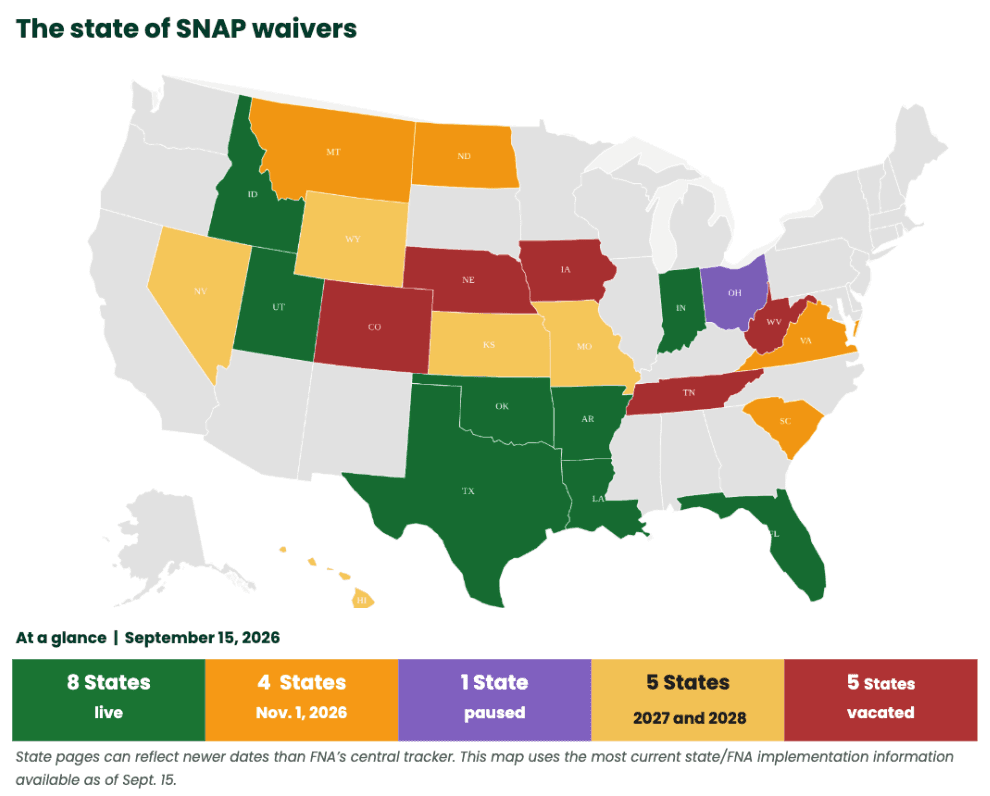
USDA approved food-restriction waivers in 23 states (see illustration below), but the implementation picture has splintered. Eight states are live, four now target Nov. 1, OH is paused, five are scheduled for 2027–28, and five approvals were vacated. The story today is less about new states joining and more about how the existing waivers are being implemented.
A court ruling across five states changed the process
A June 22 ruling (Aragon v. Rollins) vacated waiver approvals for CO, IA, NE, TN and WV; USDA has appealed. Since then, FNA has asked some unaffected states to delay or pause, and on Sept. 15 published Federal Register notices seeking public comment on multiple state waivers. That added procedural layer is a key post-Aragon development to watch.
Launch dates can move after product work has started
SC and ND recently shifted to Nov. 1; MT and VA also now target Nov. 1; Ohio’s planned Oct. 1 launch is paused altogether. For product teams, implementation dates should be treated as versioned configuration and not hard-coded assumptions.
Online is squarely in scope
Virginia explicitly says the same eligibility rules apply online and in stores, and retailers must update checkout systems so restricted products do not process against SNAP. Increasingly, the answer to “Is this SNAP eligible?” depends on the product, the state and the effective date.
The next change to SNAP eligible foods could be national
USDA has listed a proposed rule to amend the national definition of SNAP “eligible food,” currently targeted for December 2026. The proposal has not yet been published, so its scope is unknown. If it moves forward, the national baseline itself could change.
The takeaway
Build for policy change, not the next waiver. Keep eligibility configurable enough to absorb new dates, new definitions and, potentially, a new federal baseline.
SNAP food-restriction waivers: 5 things we’re seeing
Klay Fennell
Head of Government, Regulatory, and External Affairs
The first state restrictions took effect on January 1st.
Nine months later, the rollout looks less linear than the original calendar suggested. Meanwhile, court action, new federal process, and moving effective dates are reshaping what product teams need to plan for.
The rollout is no longer one straight line
USDA approved food-restriction waivers in 23 states (see illustration below), but the implementation picture has splintered. Eight states are live, four now target Nov. 1, OH is paused, five are scheduled for 2027–28, and five approvals were vacated. The story today is less about new states joining and more about how the existing waivers are being implemented.
A court ruling across five states changed the process
A June 22 ruling (Aragon v. Rollins) vacated waiver approvals for CO, IA, NE, TN and WV; USDA has appealed. Since then, FNA has asked some unaffected states to delay or pause, and on Sept. 15 published Federal Register notices seeking public comment on multiple state waivers. That added procedural layer is a key post-Aragon development to watch.
Launch dates can move after product work has started
SC and ND recently shifted to Nov. 1; MT and VA also now target Nov. 1; Ohio’s planned Oct. 1 launch is paused altogether. For product teams, implementation dates should be treated as versioned configuration and not hard-coded assumptions.
Online is squarely in scope
Virginia explicitly says the same eligibility rules apply online and in stores, and retailers must update checkout systems so restricted products do not process against SNAP. Increasingly, the answer to “Is this SNAP eligible?” depends on the product, the state and the effective date.
The next change to SNAP eligible foods could be national
USDA has listed a proposed rule to amend the national definition of SNAP “eligible food,” currently targeted for December 2026. The proposal has not yet been published, so its scope is unknown. If it moves forward, the national baseline itself could change.
The takeaway
Build for policy change, not the next waiver. Keep eligibility configurable enough to absorb new dates, new definitions and, potentially, a new federal baseline.
SNAP food-restriction waivers: 5 things we’re seeing
Klay Fennell
Head of Government, Regulatory, and External Affairs
The first state restrictions took effect on January 1st.
Nine months later, the rollout looks less linear than the original calendar suggested. Meanwhile, court action, new federal process, and moving effective dates are reshaping what product teams need to plan for.
The rollout is no longer one straight line
USDA approved food-restriction waivers in 23 states (see illustration below), but the implementation picture has splintered. Eight states are live, four now target Nov. 1, OH is paused, five are scheduled for 2027–28, and five approvals were vacated. The story today is less about new states joining and more about how the existing waivers are being implemented.
A court ruling across five states changed the process
A June 22 ruling (Aragon v. Rollins) vacated waiver approvals for CO, IA, NE, TN and WV; USDA has appealed. Since then, FNA has asked some unaffected states to delay or pause, and on Sept. 15 published Federal Register notices seeking public comment on multiple state waivers. That added procedural layer is a key post-Aragon development to watch.
Launch dates can move after product work has started
SC and ND recently shifted to Nov. 1; MT and VA also now target Nov. 1; Ohio’s planned Oct. 1 launch is paused altogether. For product teams, implementation dates should be treated as versioned configuration and not hard-coded assumptions.
Online is squarely in scope
Virginia explicitly says the same eligibility rules apply online and in stores, and retailers must update checkout systems so restricted products do not process against SNAP. Increasingly, the answer to “Is this SNAP eligible?” depends on the product, the state and the effective date.
The next change to SNAP eligible foods could be national
USDA has listed a proposed rule to amend the national definition of SNAP “eligible food,” currently targeted for December 2026. The proposal has not yet been published, so its scope is unknown. If it moves forward, the national baseline itself could change.
The takeaway
Build for policy change, not the next waiver. Keep eligibility configurable enough to absorb new dates, new definitions and, potentially, a new federal baseline.
SNAP food-restriction waivers: 5 things we’re seeing
Klay Fennell
Head of Government, Regulatory, and External Affairs
The first state restrictions took effect on January 1st.
Nine months later, the rollout looks less linear than the original calendar suggested. Meanwhile, court action, new federal process, and moving effective dates are reshaping what product teams need to plan for.
The rollout is no longer one straight line
USDA approved food-restriction waivers in 23 states (see illustration below), but the implementation picture has splintered. Eight states are live, four now target Nov. 1, OH is paused, five are scheduled for 2027–28, and five approvals were vacated. The story today is less about new states joining and more about how the existing waivers are being implemented.
A court ruling across five states changed the process
A June 22 ruling (Aragon v. Rollins) vacated waiver approvals for CO, IA, NE, TN and WV; USDA has appealed. Since then, FNA has asked some unaffected states to delay or pause, and on Sept. 15 published Federal Register notices seeking public comment on multiple state waivers. That added procedural layer is a key post-Aragon development to watch.
Launch dates can move after product work has started
SC and ND recently shifted to Nov. 1; MT and VA also now target Nov. 1; Ohio’s planned Oct. 1 launch is paused altogether. For product teams, implementation dates should be treated as versioned configuration and not hard-coded assumptions.
Online is squarely in scope
Virginia explicitly says the same eligibility rules apply online and in stores, and retailers must update checkout systems so restricted products do not process against SNAP. Increasingly, the answer to “Is this SNAP eligible?” depends on the product, the state and the effective date.
The next change to SNAP eligible foods could be national
USDA has listed a proposed rule to amend the national definition of SNAP “eligible food,” currently targeted for December 2026. The proposal has not yet been published, so its scope is unknown. If it moves forward, the national baseline itself could change.
The takeaway
Build for policy change, not the next waiver. Keep eligibility configurable enough to absorb new dates, new definitions and, potentially, a new federal baseline.
SNAP food-restriction waivers: 5 things we’re seeing
Klay Fennell
Head of Government, Regulatory, and External Affairs
The first state restrictions took effect on January 1st.
Nine months later, the rollout looks less linear than the original calendar suggested. Meanwhile, court action, new federal process, and moving effective dates are reshaping what product teams need to plan for.
The rollout is no longer one straight line
USDA approved food-restriction waivers in 23 states (see illustration below), but the implementation picture has splintered. Eight states are live, four now target Nov. 1, OH is paused, five are scheduled for 2027–28, and five approvals were vacated. The story today is less about new states joining and more about how the existing waivers are being implemented.
A court ruling across five states changed the process
A June 22 ruling (Aragon v. Rollins) vacated waiver approvals for CO, IA, NE, TN and WV; USDA has appealed. Since then, FNA has asked some unaffected states to delay or pause, and on Sept. 15 published Federal Register notices seeking public comment on multiple state waivers. That added procedural layer is a key post-Aragon development to watch.
Launch dates can move after product work has started
SC and ND recently shifted to Nov. 1; MT and VA also now target Nov. 1; Ohio’s planned Oct. 1 launch is paused altogether. For product teams, implementation dates should be treated as versioned configuration and not hard-coded assumptions.
Online is squarely in scope
Virginia explicitly says the same eligibility rules apply online and in stores, and retailers must update checkout systems so restricted products do not process against SNAP. Increasingly, the answer to “Is this SNAP eligible?” depends on the product, the state and the effective date.
The next change to SNAP eligible foods could be national
USDA has listed a proposed rule to amend the national definition of SNAP “eligible food,” currently targeted for December 2026. The proposal has not yet been published, so its scope is unknown. If it moves forward, the national baseline itself could change.
The takeaway
Build for policy change, not the next waiver. Keep eligibility configurable enough to absorb new dates, new definitions and, potentially, a new federal baseline.
SNAP food-restriction waivers: 5 things we’re seeing
Klay Fennell
Head of Government, Regulatory, and External Affairs
The first state restrictions took effect on January 1st.
Nine months later, the rollout looks less linear than the original calendar suggested. Meanwhile, court action, new federal process, and moving effective dates are reshaping what product teams need to plan for.
The rollout is no longer one straight line
USDA approved food-restriction waivers in 23 states (see illustration below), but the implementation picture has splintered. Eight states are live, four now target Nov. 1, OH is paused, five are scheduled for 2027–28, and five approvals were vacated. The story today is less about new states joining and more about how the existing waivers are being implemented.
A court ruling across five states changed the process
A June 22 ruling (Aragon v. Rollins) vacated waiver approvals for CO, IA, NE, TN and WV; USDA has appealed. Since then, FNA has asked some unaffected states to delay or pause, and on Sept. 15 published Federal Register notices seeking public comment on multiple state waivers. That added procedural layer is a key post-Aragon development to watch.
Launch dates can move after product work has started
SC and ND recently shifted to Nov. 1; MT and VA also now target Nov. 1; Ohio’s planned Oct. 1 launch is paused altogether. For product teams, implementation dates should be treated as versioned configuration and not hard-coded assumptions.
Online is squarely in scope
Virginia explicitly says the same eligibility rules apply online and in stores, and retailers must update checkout systems so restricted products do not process against SNAP. Increasingly, the answer to “Is this SNAP eligible?” depends on the product, the state and the effective date.
The next change to SNAP eligible foods could be national
USDA has listed a proposed rule to amend the national definition of SNAP “eligible food,” currently targeted for December 2026. The proposal has not yet been published, so its scope is unknown. If it moves forward, the national baseline itself could change.
The takeaway
Build for policy change, not the next waiver. Keep eligibility configurable enough to absorb new dates, new definitions and, potentially, a new federal baseline.
Begin accepting SNAP EBT and EBT Cash
Learn how Forage unlocks new revenue streams for merchants of all shapes and sizes.




Begin accepting SNAP EBT and EBT Cash
Learn how Forage unlocks new revenue streams for merchants of all shapes and sizes.
Begin accepting SNAP EBT and EBT Cash
Learn how Forage unlocks new revenue streams for merchants of all shapes and sizes.
Begin accepting SNAP EBT and EBT Cash
Learn how Forage unlocks new revenue streams for merchants of all shapes and sizes.
Begin accepting SNAP EBT and EBT Cash
Learn how Forage unlocks new revenue streams for merchants of all shapes and sizes.
Begin accepting SNAP EBT and EBT Cash
Learn how Forage unlocks new revenue streams for merchants of all shapes and sizes.
Begin accepting SNAP EBT and EBT Cash
Learn how Forage unlocks new revenue streams for merchants of all shapes and sizes.
Forage is equal opportunity. ©️ 2026 Forage Technology Corporation, Inc.
Forage is equal opportunity. ©️ 2026 Forage Technology Corporation, Inc.
Forage is equal opportunity. ©️ 2026 Forage Technology Corporation, Inc.
Forage is equal opportunity. ©️ 2026 Forage Technology Corporation, Inc.
Forage is equal opportunity. ©️ 2026 Forage Technology Corporation, Inc.
Forage is equal opportunity. ©️ 2026 Forage Technology Corporation, Inc.
Forage is equal opportunity. ©️ 2026 Forage Technology Corporation, Inc.